
Bedding Sets
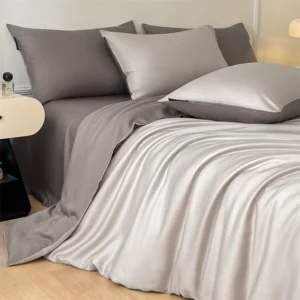
| Materials | Cotton · Poly-Cotton · Modal Blend · Bamboo Fiber · Cotton-Linen · Organic Cotton |
| Yarn Count / Thread Count | 20s–80s / 130–500TC |
| Size Range | US Twin–Cal King · UK Single–Super King · EU, Nordic, Asia — custom sizes available |
| MOQ | 500 sets per color · 200 sets per design (see MOQ section below) |
| Lead Time | Sampling 7–10 days · Production 25–35 days |
| Customization | Color · Size · Logo · Packaging |
What We Can Do
Materials. 100% cotton — carded, combed, or long-staple options. Poly-cotton blends — TC 65/35 through CVC 55/45. Modal-cotton and bamboo viscose blends for brands selling softness. Cotton-linen for a textured, natural hand. Solid-dyed or yarn-dyed stripes and checks.
Yarn count and density. From 20s entry-level carded cotton up to 80s long-staple sateen. Poly-cotton from 130TC to 300TC. 100% cotton sateen can reach 300–500TC.
Weave construction. Percale for a crisp, breathable finish. Sateen for sheen and a smoother hand. Dobby and Jacquard for textured patterns — stripes, geometrics, brand-specific designs.
Sizes. Any standard or non-standard dimension. US sizing (Twin through Cal King), UK (Single through Super King), European and Nordic variants, Asian market dimensions, hotel-specific sizes. If you have a cut sheet, we can match it.
Color. Dyed to Pantone reference — solid colors or yarn-dyed multi-color schemes. Color matching across production lots is part of standard QC, not an upsell.
Packaging. Retail box with brand insert card. Bulk hotel packaging — PE bag with label. Compressed roll-pack for e-commerce. Woven labels or heat-transfer logo prints.
Material Selection: Start With the End-Use, Not the Fiber
There is no “best material.” There’s a best material for your guest’s climate, your laundry’s wash temperature, and the price point your brand needs to hit.
Hotel chains — controlling cost per wash
Start with TC 65/35 poly-cotton. Wash life of 200–250 cycles. Less wrinkling out of the dryer, less pressing time. Feels crisp out of the package, softens noticeably after 5–10 industrial washes. Do not judge a 65/35 sheet by its out-of-box hand feel — it changes.
If your property markets “cotton feel” but can accept a small polyester component for dimensional stability, CVC 55/45 or 60/40 keeps shrinkage under 2% — compared to 3–5% for 100% cotton — while feeling close enough to cotton that most guests won’t register the difference.
Boutique hotels and DTC brands — selling hand feel
Long-staple cotton sateen at 60s–80s / 300–500TC. The sateen weave gives it the sheen. Use combed yarn as the raw material — not all long-staple cotton goes through combing, but for hotel bedding, combing matters more than staple length for pilling performance.
For brands running a sustainability angle, GOTS-certified organic cotton delivers identical performance to equivalent combed cotton at a 20–30% cost premium. What you’re buying is the traceable certification, not a performance upgrade.
Hot-climate markets — cooling touch
Bamboo viscose-cotton blend at 70/30 cotton/bamboo. The cooling sensation on skin contact is measurable — bamboo viscose has higher thermal conductivity than cotton. Moisture absorption also edges out 100% cotton. Two caveats worth knowing upfront: over 95% of “bamboo fiber” on the market is bamboo viscose, not mechanically processed bamboo — the antimicrobial claim that comes with mechanical bamboo does not survive the viscose process. And pilling tendency is higher than 100% cotton at the same yarn quality.
Modal-cotton blend at 60/40 or 70/30 is softer than bamboo viscose and has better wet strength, but the fiber cost is higher. More common in mid-to-premium retail than in cost-sensitive wholesale.
Temperate markets, budget-driven procurement
TC 65/35 at mid-range yarn counts — 30s–40s, around 200TC. Fabric cost runs 30–40% below 100% cotton, wash life is higher, and the guest experience is entirely acceptable in segments where bedding isn’t the selling point.
The short version: pick the scenario first, then the fiber. Not sure where your customer fits? Send us the guest profile, laundry setup, and target price bracket. We’ll recommend the ratio.
Quality Control and Service
Sampling. Confirm material and construction → pre-production sample ships in 7–10 days. After sample approval, bulk production lead time is 25–35 days depending on order volume and process complexity.
Inspection. Third-party inspection available before shipment — SGS, Intertek, or equivalent. Factory inspection is also available if your sourcing team wants to walk the line.
Testing standards applied in production:
- Yarn evenness: Uster CVm% control across lots
- Colorfastness: AATCC 8 (dry crocking) ≥ Grade 4, AATCC 61 (laundering) ≥ Grade 4
- Shrinkage: 100% cotton < 5%, poly-cotton < 2%, modal blends < 5%
- Pilling: ISO 12945-2 ≥ Grade 3–4
- Color consistency: Delta E ≤ 1.0 on production lots
- Chemical safety: OEKO-TEX Standard 100 — available on request
MOQ: Why the Number Is What It Is
Standard MOQ is 500 sets per colorway, with a minimum of 200 sets per design.
This isn’t an arbitrary floor. Fabric dyeing and warping have real minimum run lengths — below 200 sets, the fixed costs of dye formulation, machine setup, and trim procurement stack up to a unit price that doesn’t reflect the product’s value. If your order is close to the boundary, we can make it work — but we’ll talk through the cost structure so neither side gets surprised.
Orders above 3,000 sets per color unlock a meaningful unit-cost step down. That’s where the fabric-level batch efficiency starts showing up in the math.