
Duvet Covers
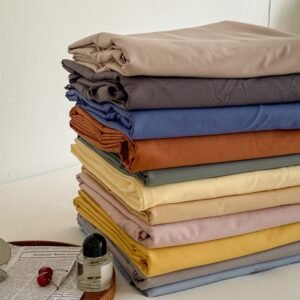
| Materials | Cotton · Poly-Cotton · Modal Blend · Bamboo Fiber · Cotton-Linen · Organic Cotton |
| Yarn Count / Thread Count | 20s–80s / 130–500TC |
| Size Range | US Twin–Cal King · UK Single–Super King · EU, Nordic, Asia — custom sizes available |
| MOQ | 500 pcs per color · 200 pcs per design (see MOQ section below) |
| Lead Time | Sampling 7–10 days · Production 25–35 days |
| Customization | Color · Size · Closure Type · Logo · Packaging |
What We Can Do
Materials. 100% cotton — carded, combed, or long-staple. Poly-cotton — TC 65/35 through CVC 55/45 for hotel programs where wash-cycle economics drive the spec. Modal-cotton and bamboo viscose blends for brands positioning on softness. Cotton-linen for a relaxed, textured look. Solid-dyed or yarn-dyed stripes and checks.
Yarn count and density. 20s carded cotton for entry-level hotel programs up to 80s long-staple sateen for premium retail. Poly-cotton from 130TC to 300TC. 100% cotton sateen at 300–500TC.
Weave construction. Percale for a crisp finish. Sateen for sheen and drape. Dobby and Jacquard for textured designs.
Closure types. Button closure — standard 4-button or extended flap with hidden buttons. Envelope closure — no hardware, common in hospitality for faster housekeeping turnover. Zipper closure — invisible zipper along the bottom seam, popular in retail for a clean look.
Sizes. Any standard or custom dimension. US, UK, European, Nordic, Asian market sizes. Hotel-specific sizing — including oversized duvet covers designed to accommodate thicker inserts.
Color. Pantone-matched solid dyeing. Yarn-dyed patterns for stripes, checks, and border details. Color consistency maintained across production lots as standard QC.
Packaging. Retail box with brand card. Bulk hotel packaging. Compressed roll-pack for e-commerce. Brand labels — woven or heat-transfer.
Material Selection: Pick the Scenario First
Hotels — built for the laundry, not the showroom
TC 65/35 is the default starting point. 200–250 wash cycles at 75°C. A duvet cover in a hotel laundry takes more mechanical abuse than a flat sheet — the tumbling action inside a large-capacity washer twists and pulls at the seams. Polyester in the blend provides the tensile backbone that keeps seam integrity through hundreds of cycles.
For properties that want a cotton-like hand, CVC 55/45 or 60/40 preserves the cotton feel while keeping shrinkage to under 2%. The closure type matters here — envelope closures on CVC duvet covers are faster to turn over than button closures, and housekeeping managers notice the 10 seconds saved per room.
Retail and DTC — the first touch closes the sale
Long-staple cotton sateen at 60s–80s / 300–500TC. This is the spec that photographs well and feels expensive in the hand. Combed yarn matters here — a duvet cover gets handled more than a sheet (changing the insert, adjusting at night), so surface smoothness is noticeable over the product’s life.
For the “ultra-soft” positioning, Modal-cotton 60/40 gives drape and a cool-to-the-touch sensation that cotton can’t match. The trade-off: wash durability below 100% cotton. But in a home-use scenario, the consumer is washing 50 times a year, not 150 — and they’re buying soft, not longevity.
Warm-climate markets
Bamboo viscose-cotton 70/30 provides measurable cooling on skin contact and better moisture absorption than 100% cotton. For duvet covers specifically — where the body is wrapped rather than just lying on top — the cooling effect is more pronounced than in a flat sheet because of the larger contact area. The pilling tendency of bamboo blends is higher than cotton — more care needed on yarn quality and weave tightness.
Quality Control and Service
Sampling. Material and construction confirmed → pre-production sample in 7–10 days. Approved sample → bulk production in 25–35 days.
Inspection. Third-party inspection (SGS, Intertek) before shipment, or factory visit. Seam strength is tested specifically on duvet covers — a closure failure is a return, and returns on bulk orders are expensive for everyone.
Testing standards:
- Yarn evenness: Uster CVm% across lots
- Seam slippage: ASTM D434 — closure seams and side seams tested separately
- Colorfastness: AATCC 8 (dry crocking) ≥ Grade 4, AATCC 61 (laundering) ≥ Grade 4
- Shrinkage: 100% cotton < 5%, poly-cotton < 2%
- Pilling: ISO 12945-2 ≥ Grade 3–4
- Color consistency: Delta E ≤ 1.0
- Chemical safety: OEKO-TEX Standard 100 — available on request
MOQ: Why the Number Is What It Is
Standard MOQ is 500 pcs per colorway, minimum 200 pcs per design.
The floor is set by fabric dyeing and warping minimums — below 200 pcs, fixed costs stop making sense for a bulk production line. If your order sits close to the threshold, we can make it work with a transparent cost discussion. Orders above 3,000 pcs per color see a unit-cost reduction driven by fabric-level batch efficiency.